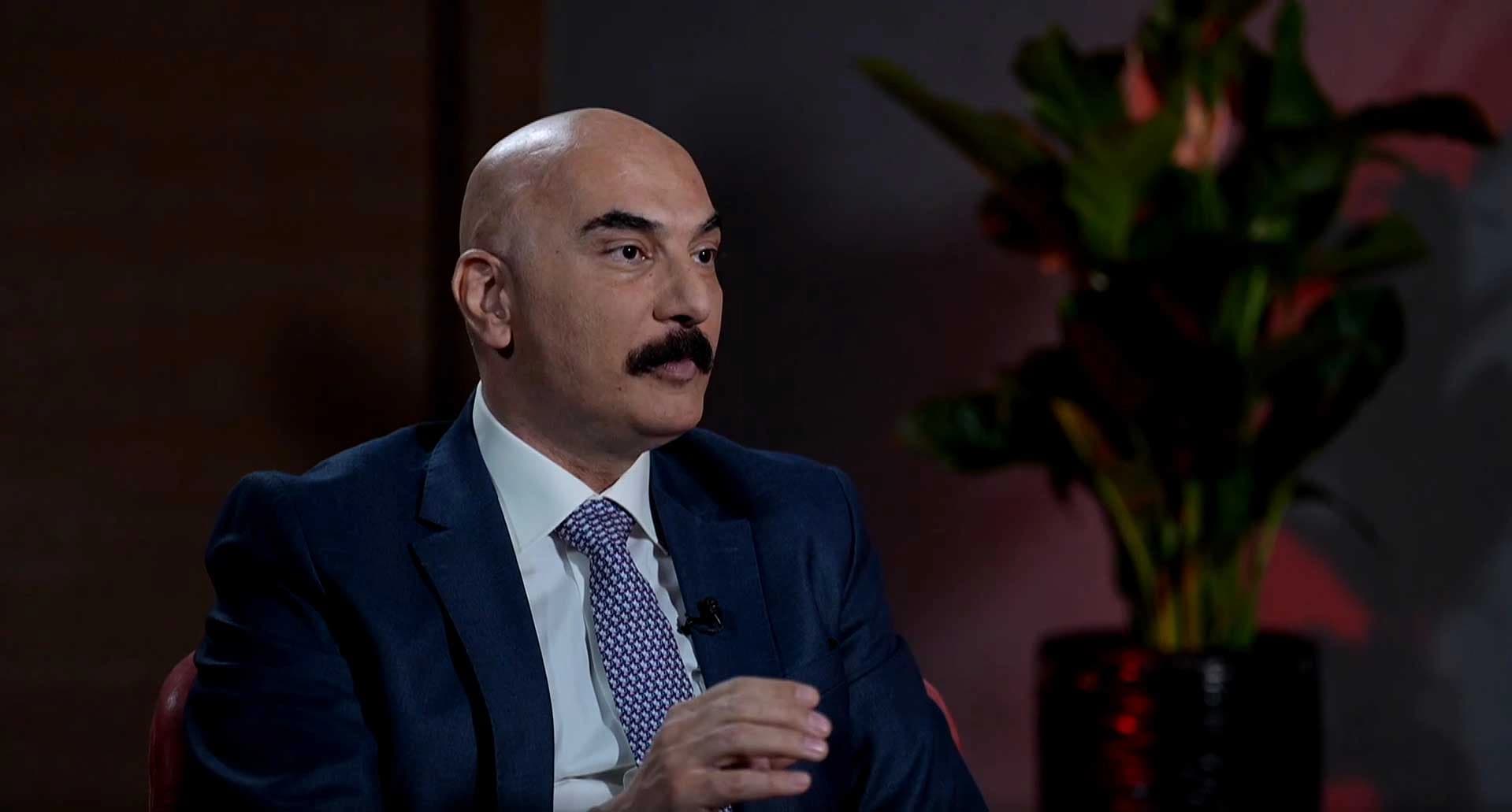
ERBIL, Kurdistan Region - The Kurdistan Region’s Peshmerga minister has expressed hope that a security agreement with the United States aimed at unifying and enhancing the capabilities of the Kurdish forces will be renewed before its expiration in September, further warning that ongoing political deadlock in the Region could jeopardize efforts to secure continued support.
In an interview with Rudaw’s Arkan Ali on Sunday, Shoresh Ismail said that the four-year Memorandum of Understanding (MoU) signed in September 2022 between his ministry - effectively the Kurdistan Region’s defense ministry - and the Pentagon is set to expire this year, bringing an end to direct US financial assistance for the Peshmerga forces.
“We have high hopes that this agreement would be renewed, and we continue to hold that hope while pursuing every possible avenue to secure its extension,” Ismail said.
He stressed that renewing the deal requires broader “diplomatic efforts,” adding that it cannot be achieved through “the efforts of the Peshmerga ministry.”
Under the MoU, partisan military structures within the Peshmerga ministry are to be integrated into a unified command structure, with all Kurdish forces brought under the ministry’s full authority by September.
The Kurdistan Region’s ruling parties, the ruling Kurdistan Democratic Party (KDP) and Patriotic Union of Kurdistan (PUK) have long maintained separate military formations - Unit 80 and Unit 70, respectively.
Around 100,000 troops have served within the latter two forces, receiving salaries and administrative directives through party-affiliated chains of command rather than a unified structure under the ministry, despite periodic tensions between the rival parties.
However, the Kurdistan Regional Government’s (KRG) Law No. 2 of 2020 - widely known as the KRG Reform Law - mandates the establishment of two military formations, Regional Command 1 and Regional Command 2, intended to integrate Unit 70 in the PUK’s stronghold of Sulaimani and Unit 80 in Erbil and Duhok, where the KDP holds sway.
While the implementation of the bill has been long delayed due to political mistrust, it is currently in its final, high-pressure push ahead of the September deadline.
For his part, Ismail emphasized the need to reactivate the Kurdish parliament and to wheel the formation of the KRG’s tenth cabinet forward to strengthen the Kurdistan Region’s positioning in Washington.
The Region held parliamentary elections in October 2024, with the KDP winning 39 seats, while the PUK secured 23 seats in the 100-seat legislature. No party achieved an outright majority, and efforts to form the KRG’s tenth cabinet have since stalled due to disputes over governance structures and key government posts.
“I am certain that if parliament were active and the government had been formed, the Kurdistan Region’s diplomatic position would have a more significant and valuable influence on the US Congress, Senate, and Department of War,” the Peshmerga minister remarked.
Addressing security challenges, Ismail said the US had agreed with Iraq to provide air defense systems capable of countering drones, missiles, and rockets, some of which are expected to be deployed in the Kurdistan Region to protect critical infrastructure, including energy facilities.
Following is the full transcript of the interview with the Kurdistan Region’s Peshmerga Minister Shoresh Ismail.
Rudaw: Mr. Shoresh, thank you very much for this opportunity. Let’s start with this: the Memorandum of Understanding (MoU) with the Pentagon regarding support for the Peshmerga forces will expire in September of this year. Is there any hope for the renewal of that understanding? Have serious talks and discussions begun to ensure that this support continues?
Shoresh Ismail: First, thank you, and I offer my respect and great love to the audiences of Rudaw. Much has been said about this topic; I would like to speak more clearly about it. We have a Memorandum of Understanding with the US Department of War for a period of four years, which was signed in September 2022. It expires in September of this year.
The financial assistance will come to an end; this expiration is not related to the current developments in the Kurdistan Region or Iraq, meaning we made this agreement four years ago. We have high hopes that this agreement would be renewed, and we continue to hold that hope while pursuing every possible avenue to secure its extension. However, I am certain that to encourage and support this renewal, diplomatic efforts are required - not just the efforts of the Peshmerga ministry. I hope that in the time remaining, we can renew this understanding.
Although a strategic dialogue has been established for an agreement between Iraq and the United States, the Peshmerga ministry is part of those discussions. The US has promised us that, within the framework of the aid they will provide to Iraq in the future, they will maintain a separate line so that Iraq itself agrees to let the US continue training and support in one way or another, albeit in a different form than the current one.
That is one point. Another point: I am certain that if the Kurdistan Parliament were active and the tenth Cabinet [of the KRG] were formed, the diplomatic platform would have a more significant and valuable influence on the US Congress, the US Senate, and the US Department of War. It is not too late; efforts have been made. I am aware that the Kurdistan Regional Government has been continuous in its efforts and has sent delegations to America, and we have been making efforts here as well, but they [the US] look at the legal framework of governance and the government.
I hope that in these days - as there is much campaigning, and recently Mr. Masoud [Barzani] released a message on the occasion of Eid [al-Adha] stating that the PUK and KDP must meet with the political parties of Kurdistan as soon as possible - I am sure that Mr. Masoud stands above the disputes. He must be above the conflicts and rivalries currently in the political arena of the Kurdistan Region so that a new government can be born as soon as possible, and the Parliament can be active. This is so that legal support for the Peshmerga ministry can be activated once again within the framework of a multi-year understanding.
Mr. Shoresh, does this mean you have come to the belief that the reactivation of the Kurdistan Parliament and the failure to form a new government will impact the future of Coalition aid and Pentagon support for the Kurdistan Region? But only three months are left; three months is very little time if nothing serious is done.
It is never too late for good work, for taking steps, and for forming the new cabinet. This might be the work of a single meeting - a meeting full of trust and understanding. I am certain that now the PUK and KDP, especially since they bear the great responsibility of protecting the entity of the Kurdistan Region, must have a clear picture before them - and it is before them. It is not a matter of saying "it takes time"; so much has been said and criticized already. Therefore, in one serious meeting, they can bring this to an end. Above all, Mr. Masoud must oversee this; as he is like a big brother in the Kurdistan Region, he is the person who must stand above all disputes and command that this agreement be made as soon as possible to end the deadlock facing the formation of the tenth cabinet.
Mr. Shoresh, you know that the continued financial support from the US and the Coalition for the Peshmerga is tied to how quickly the 70 and 80 Units are unified. What has been done for this? Approximately what percentage of the work is complete? What are the obstacles? Who are the spoilers? You have been working on this for a long time; this is not a new topic.
Certainly, good work has been done. If you compare the Ministry from the beginning of the 9th cabinet when we joined until now, the Ministry is unrecognizable because of the positive changes and the very good steps taken with everyone's support. Perhaps a portion remains that should have been finished, but those obstacles and problems existed.
I will return to the answer to your question about why this has an impact. Certainly, the failure to form a new cabinet and the failure to reactivate the Parliament affects every single individual in Kurdistan; therefore, it has a direct impact on the Peshmerga ministry. Thus, I can say that the vast majority of the work in the process of reform, unification, and reorganization of the Kurdistan Peshmerga forces is complete.
If a part remains, it is the part that, as the President of the Region said during the graduation of the Zakho [military college], "We are all embarrassed before the Americans." In that sense, the embarrassment is that these five... I agree that the reform process is difficult for the two partisan forces. It is not easy to bring two partisan forces under the umbrella of the Peshmerga ministry, reorganize them, and make them beholden to the military laws.
Mr. Shoresh, how many of the 70 and 80 brigades? How much has been done in terms of numbers?
Most of the brigades. We are currently in the process of creating 11 divisions along with a command. Region One is complete; Region Two will likely be finished in these next one or two weeks. Therefore, it is heading toward completion. But it is better for this to end as soon as possible. Certainly, the Americans, British, Germans, Italians, and even the Dutch - these five countries that call themselves the MNAG [Multi-National Advisory Group] - have directly supervised the reform process in the Peshmerga ministry; therefore, they will also be satisfied and happy, as they have set a deadline [for the process]. Although we have discussions with them and they understand the situation, it is better to complete the remaining part, which could perhaps be finished within two weeks.
Mr. Shoresh, the truth is that the problem with not unifying Unit 70 and 80 forces sooner has been related to the disputes between the PUK and KDP. If you were to tell the people frankly, what are the disputes? For example, is it over the ranks and positions of the brigades or the divisions?
Within the Peshmerga ministry, we have very few problems left. I can say that within the Ministry, we are a unified team.
Is there no longer any bias for Yellow [KDP] and Green [PUK]?
Perhaps a little remains, but this process of reorganization and unification takes time. When you reorganize this force, you provide for their livelihood, provide them with weapons, provide good barracks, and solve their individual problems - like family or illness... these things have all been progressed step by step. When these issues are resolved and improved, the officers and soldiers - although they still have an affinity for Kurdistan - will gradually gain affinity for Kurdistan, because this force has originated from that.
The 70 and 80 Units have a history full of pride and glory, having struggled under the leadership of the PUK and KDP against Saddam [Hussein], ISIS [Islamic State], and others. But this stage is a stage where they must become a unified, regular Kurdistan force. Gradually, this affinity changes in another way; the [political] affinity will remain… but when they come under the umbrella and control of the Peshmerga ministry, they must adhere to the law. For example, currently, a Peshmerga receives half the salary of an Iraqi soldier; you must provide them with these rights and entitlements.
We can resolve these in the future through continuous dialogue between the KRG and the Iraqi government. Once all their needs are addressed, their affinity will change. The party affinity will remain, but it will be deeper for Kurdistan. When it comes to voting, their stance for their party will be a stance for voting, while through these beautiful actions, they become a beautiful and pure mirror within that force. One might say an officer who has an affinity for a political party is doing his military duty successfully and tirelessly. This is a success for the party as well.
Mr. Shoresh, let me move to the first point: in the event that the financial support from the Coalition is cut off, that’s a hypothesis. What will Kurdistan do to fill that gap of 15 to 20 million dollars per month?
The Kurdistan Regional Government must find the budget for it from wherever it can. You know the Peshmerga force is a consuming ministry; it has no "product" at this stage. Perhaps at a stage when the region is stable and the Peshmerga force has completed all other stages, it can have production, but at this current stage, it has no revenue. The Kurdistan Regional Government must [provide] - not just the current budget, which is a small budget. We cannot manage the infrastructure of the Peshmerga ministry with it. If we compare it to the Iraqi forces, the budget of the Peshmerga ministry is very small; we are very frugal and have managed to run our affairs with it.
Mr. Shoresh, in the past few months when there was tension between Iran, the US, and Israel, the biggest demand was that the Peshmerga ministry needs a defense system. What exists so far is that there is no defense system for the Ministry, or it is not robust. What have you done to fill that security gap? Both in terms of asking the Coalition and in efforts to establish a defense system for the Ministry?
Partly, the US has agreed with Iraq that anti-drone systems - not just anti-drone, but anti-missile and anti-rocket as well - will come to Iraq and be provided for the Kurdistan Region too, especially for important locations like the Dana Gas operating site [Khor Mor gas field], the Council of Ministers, and the Presidency as a first phase. We in the Peshmerga ministry have taken steps; regarding the knowledge and information related to drones, anti-drones, and drone protection, we have taken serious steps and obtained that information.
Meaning those drones that were shot down during the tensions over the airports and facilities of the Kurdistan Region - were they shot down by the Peshmerga ministry or the Coalition?
I say with certainty that so far, we have not been able to benefit from this advanced technology. But we are trying. You see that Iraq, in this regard, does not allow the Peshmerga ministry a free hand in receiving advanced weapons from countries so that it can defend itself.
Iraq's own defense system isn't very robust either, as missiles are still hitting Iraq.
Correct, but you start from the first step. And the first step is not to create an Iron Dome over the Kurdistan Region or Iraq. Now, more importance is given to technology rather than large armies, tanks, and armored vehicles. I am sure the Peshmerga ministry has a high readiness to solve this problem itself in that regard.
Mr. Shoresh, there is talk that in this new government cabinet led by Zaidi [Prime Minister Ali al-Zaidi], the protection of oil fields in all of Iraq, including Kurdistan, will be by the [Iraqi] Army, or a specific Iraqi institution. How true is this?
I do not know of any official place where this has come from. All these words and steps must [respect that] Iraq is a federal country and must be strong in terms of democratic institutions. The strengthening of democratic institutions throws out this centralized mentality and brings forward a mindset that all these things must be done through dialogue and discussion.
I am sure the new Iraqi cabinet, under the supervision of Mr. Zaidi, if such a topic arises, will have the necessary discussions with the Kurdistan Region. Currently, the force protecting Khor Mor - which is an economic and vital center for the Kurdistan Region and the area for gas and electricity - is protected by several emergency defense brigades. If that force were not there, ISIS would have expanded in that area and perhaps caused heavy damage. But a Peshmerga force is present there and has the responsibility to protect the fields. If the ground force was not present in the area, big problems might erupted for Dana Gas and the area. If there is talk about that, it must be discussed with the Kurdistan Regional Government.
Mr. Shoresh, where did the joint brigades that were supposed to be formed between the Kurdistan Region and Iraq reach?
Those two joint brigades have been formed and are in their positions. Those who were sent for training on anti-drone systems to protect the gas fields, like that of Dana Gas, were from those joint brigades.
How many joint brigades do we have?
Two brigades.
How many brigades are left?
They are still present.
Will they not increase?
They must be increased according to need. Now, ISIS has become a wide terrorist network and has sleeper cells. Perhaps confronting ISIS and the ISIS ideology requires its own methods and environment. The environment in which ISIS was nurtured, I believe, still exists, and the ISIS ideology exists in those areas in another form. They have opened thousands of pages on social media and are active there.
Do you believe the ideological base of ISIS still exists and the potential for resurgence?
Definitely. Because the environment in which they grew remains - even if it is not under the name of ISIS, it still exists. Therefore, Iraq must strengthen its democratic institutions and implement the articles present in the Constitution… If the Constitution is implemented, Article 140 will not remain like a time bomb in those areas. I am not in favor of Iraq being strong militarily; rather, it must be strong in terms of democratic institutions so that terror does not grow in a democratic environment.
Mr. Shoresh, efforts have now begun in Iraq for groups to lay down their arms. Several groups have shown their goodwill. How do you view this process? Is it important? Isn't it a bit difficult to integrate a group that for years has had an affinity for a sect or a religious authority into the Iraqi Army? Isn't it difficult?
Certainly, it is a good step. But before they join the army, in my opinion, they must be rehabilitated so that they join the army with a more moderate mindset. This is the government's duty. Those forces should not be integrated into the army with this [current] anger; rather, there should be a place for the rehabilitation of those forces so that the army being created now is very, very different and part of the solution to political disputes. It has also been stated in the constitution this way. This is a good step that needs to be taken.
Secondly, the Popular Mobilization Forces [PMF] was created in a special situation, after the fatwa [religious edict] of the Supreme Religious Shiite Authority [Grand Ayatollah Ali al-Sidtani] against ISIS, and they performed their duty successfully. The PMFi is very, very different from the Kurdistan Peshmerga forces.
The Peshmerga force existed before the creation of this government and before Saddam; it has defended the survival of the Kurds. The Peshmerga force is the heir to 100 years of struggle and sacrifice by the people of Kurdistan. A special situation or a fatwa did not create it. A long history created that force. Therefore, talking about this force... the Constitution has recognized it as a legitimate force, and it has always been the pillar of security and stability. The Peshmerga has become an international symbol, not only within Iraq…
Mr. Shoresh, in one minute - if you could tell me - where have the latest efforts for the promotion of Peshmerga officers reached?
The work is proceeding in a natural way. Every year we send two schedules to the Council of Ministers, both at Newroz and in September… The process is continuous and has taken its legal and natural framework; the officers should be assured.