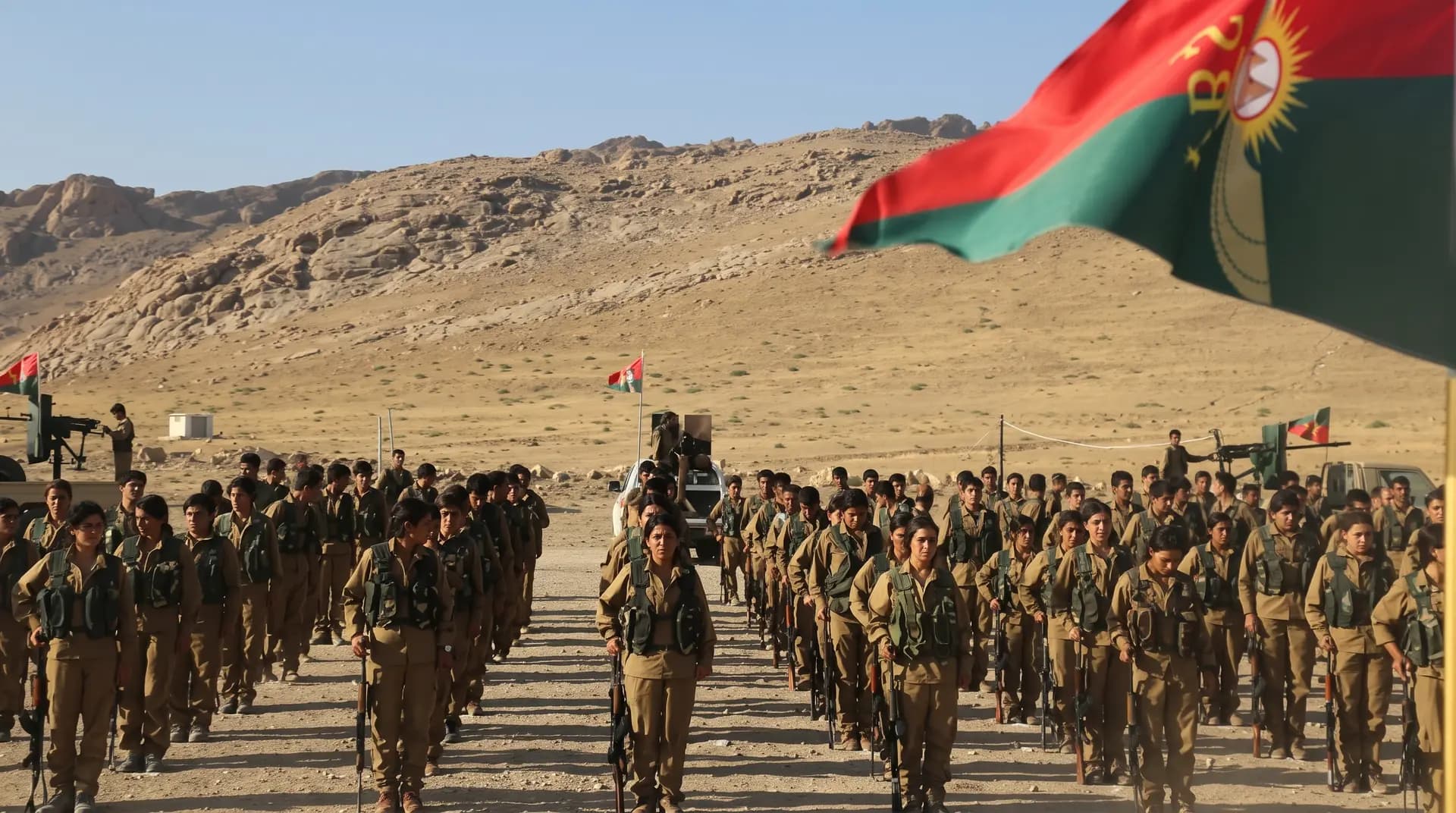

ERBIL, Kurdistan Region - Around 2,000 members of the all-Yazidi Shingal Resistance Units (YBS) are scheduled to formally join Iraq’s security forces on Monday as part of an agreement to bring the Yazidi heartland of Shingal (Sinjar) district under Baghdad’s full authority, a senior source from the force told Rudaw.
A senior commander of the YBS told Rudaw's Aziz Sharkani that the first phase would see 2,000 fighters incorporated into state security institutions, while “between 3,000 to 4,000 more of our fighters who are local residents will be officially integrated in upcoming phases.”
The ceremony is scheduled to take place on Mount Shingal in Nineveh province, in the presence of senior commanders from the Iraqi security forces, including representatives of the 20th Division, the Joint Operations Command and the West Nineveh Command, alongside commanders from the YBS and its all-female force.
The integration process follows Iraqi Prime Minister Ali al-Zaidi’s announcement last month that the government had reached an understanding with the YBS to transfer control of Mount Shingal to federal authorities as part of an agreement to restore federal control over Shingal and bring the group’s fighters into state institutions.
Sabah al-Numan, Zaidi’s military spokesperson, confirmed on Monday that the military disengagement ceremony would take place under the supervision of the prime minister, with the process encompassing the integration of the units into state institutions and the transfer of security responsibility for Mount Shingal to federal authorities.
The move, Numan said, forms part of the government’s policy to consolidate all weapons under state control and establish a new framework for security responsibility in the Yazidi town.
“The federal government reaffirms its full responsibility to uphold the rights of the Yazidi community members who fought against terrorism and bravely confronted its extremist agenda - a struggle that resulted in martyrs and the wounded,” Numan said.
He added that the government remained committed to compensating victims’ families and those affected by terrorist operations, as well as rebuilding Shingal.
Mohammed Jasim Kakayi, head of the Security and Defense Committee in the Nineveh provincial council, estimates the number of fighters integrating into the security forces in the first phase to be between 1,500 and 2,000.
Speaking to Rudaw's Nahro Mohammed on Monday, he said that “a high-level security delegation from Baghdad will arrive today in Nineveh province and visit Shingal district,” adding that “YBS forces are scheduled to officially announce their integration into the framework of the Iraqi security forces during a press conference.”
The fighters will be distributed among the Iraqi Army, local police and the Popular Mobilization Forces (PMF). Kakayi said some would remain within the PMF as part of the Yazidi Hashd, while female fighters would join the Nineveh Police’s female police division.
The precise number of recruits and the terms governing the integration remain unsettled. Murad Ismail, a Yazidi member of Iraq’s parliament, told Rudaw English on Saturday that the force comprises approximately 4,160 fighters, but not all would necessarily be absorbed into the security apparatus.
“Their total is approximately 4,160 fighters. However, a final agreement regarding the full number has not yet been reached, and not all of them will necessarily be recruited into security agencies; rather, some will return entirely to civilian life,” Ismail said.
He added that several YBS military outposts on Mount Shingal would be handed over to the Iraqi Army as part of the initial phase, while other fighters would enter local police ranks or relinquish their weapons and return to civilian life.
Dakhil Murad Hassan, head of the Shingal Tribal Board affiliated with the Sinjar Resistance Units (YBS), confirmed to Rudaw on Monday that “a total of 4,200 to 4,300 fighters will be integrated into the Iraqi security forces.”
He added that 1,000 fighters would be incorporated into the PMF, with 500 assigned to secure southern Shingal and the remaining 500 tasked with protecting the northern part of Mount Shingal.
Regarding the foreign fighters, Hassan said that they would not be included in the integration process. "They would either remain in Sulaimani and other provinces of the Kurdistan Region, return to their homes and families, or leave for another country."
He also said the YBS had suffered significant losses during its operations in Shingal, saying that 5,030 of its fighters had been killed and more than 4,000 wounded.
The Iraqi security forces and YBS commanders are expected to issue a joint statement outlining the agreement’s details following the ceremony. Rudaw has learned that media access to the event has been restricted to four Iraqi Arab outlets and three media organizations close to the YBS.
YBS-affiliated media published footage showing preparations for the event.
The integration agreement also follows years of negotiations over the YBS’s status and the fragmented security arrangements in Shingal, which lies west of Mosul and is part of Nineveh province, a territory disputed between Baghdad and the Kurdistan Regional Government (KRG).
The YBS emerged as a local Yazidi armed group and expanded significantly after the Islamic State (ISIS) attacked Sinjar in August 2014, killing and abducting thousands of Yazidis in a campaign recognized as genocide. The group developed close ties with the Kurdistan Workers’ Party (PKK), whose fighters helped establish an escape corridor for Yazidis trapped on Mount Shingal during the offensive.
Parts of the YBS were subsequently incorporated into Iraq’s state-funded PMF, while the group retained an independent armed presence in the district. Its female fighters operate through a separate formation known as the Shingal Women’s Units.
The October 2020 Shingal Agreement, brokered between Baghdad and Erbil under United Nations supervision, envisaged the normalization of the district’s security and administrative situation, including the withdrawal of unauthorized armed formations. However, implementation has remained incomplete amid disagreements over local governance and the presence of PKK-affiliated forces.
Turkey considers the YBS linked to the PKK and has repeatedly targeted its positions and commanders in Sinjar through airstrikes.
Updated at 11:11 am.