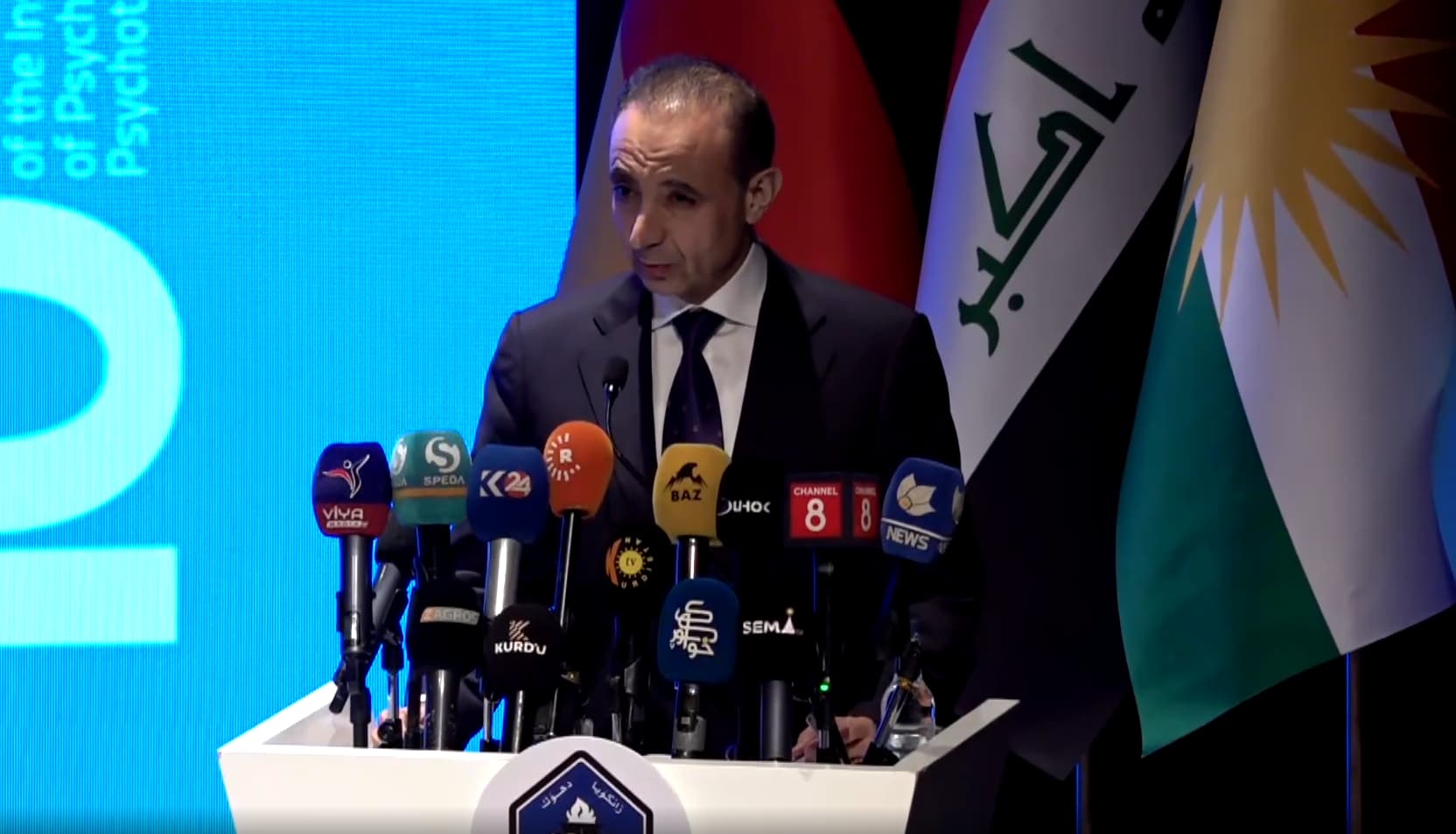

ERBIL, Kurdistan Region - Kurdistan Region President Nechirvan Barzani on Sunday called for expanded psychological treatment services for survivors of war and displacement, describing the treatment of those affected as a shared responsibility during a ceremony that marked the 10th anniversary of the Institute of Psychotherapy and Psychotraumatology (IPP).
Speaking on behalf of President Barzani, presidential spokesperson Dilshad Shahab said the authorities had a responsibility to support Yazidi survivors in rebuilding their lives and restoring their confidence and hope for the future.
“It is our responsibility not to leave those who have experienced such tragedies alone. We must help them regain their lives, their confidence, and their hope for a better future,” Shahab said, reading a statement on behalf of Barzani.
The speech commemorated the 10th anniversary of the IPP at the University of Duhok. The institute was established to provide sustained mental health care and rehabilitation to survivors of the Islamic State (ISIS) genocide perpetrated against the Yazidis in 2014.
President Barzani’s statement also highlighted the significance of the correct environment for survivors.
“It is important that everyone in need of psychological assistance understand that seeking treatment is entirely natural and that no one should feel ashamed or uncomfortable doing so,” he said.
President Barzani praised the institute's work in Duhok and Shingal (Sinjar), particularly its treatment services and training of specialists, and called for continued government and international support to expand access to psychological care in areas affected by violence and displacement.
“The people of Kurdistan and Iraq have endured many years of war and hardship,” he said, describing the genocide committed by ISIS against the Yazidis as one of the most horrific tragedies.
The UN has officially recognised the atrocities committed by ISIS against the Yazidis as a genocide that killed thousands, led to the abductions of over 6,000, and has left nearly 200,000 people currently displaced.
The president also reaffirmed his support for Yazidi rights, saying any plan to resolve problems in Shingal and elsewhere must be based on “their demands and interests.”
Jan Ilhan Kizilhan, the institute's founding dean, told Rudaw on Sunday that the German government supported the creation of a psychotherapy training center that respectfully served communities in their own language.
“We wanted to establish a psychotherapy center here that had not existed in the Middle East,” Kizilhan said, explaining that the aim was to train local specialists who could be the best people to support their communities.
He said the institute trains people from different parts of the Kurdistan Region and religious backgrounds, including Yazidis and Muslims.
Kizilhan recalled the ISIS genocide in 2014 against the Yazidis and said he had examined around 1,400 Yazidi women and girls after visiting displacement camps in 2015.
Working with the German government and the local government of Baden-Württemberg, he explained how the project eventually took 1,100 Yazidi women and children to Germany for treatment and support.
“We cannot take all Yezidis or refugees to Germany. And this is also not right, because they belong here,” Kizilhan said in his speech at the ceremony, explaining the motivation behind establishing the institute in the Kurdistan Region.
He reiterated that the institute was intended to build local capacity so survivors could receive specialized care without having to leave their homeland.
Authorities continue to deal with the consequences of ISIS’ actions. On Sunday, the Kurdistan Regional Government’s (KRG) Ministry of Matyrs and Anfal Affairs announced that it was preparing to exhume 18 mass graves that date back to the ISIS genocide.