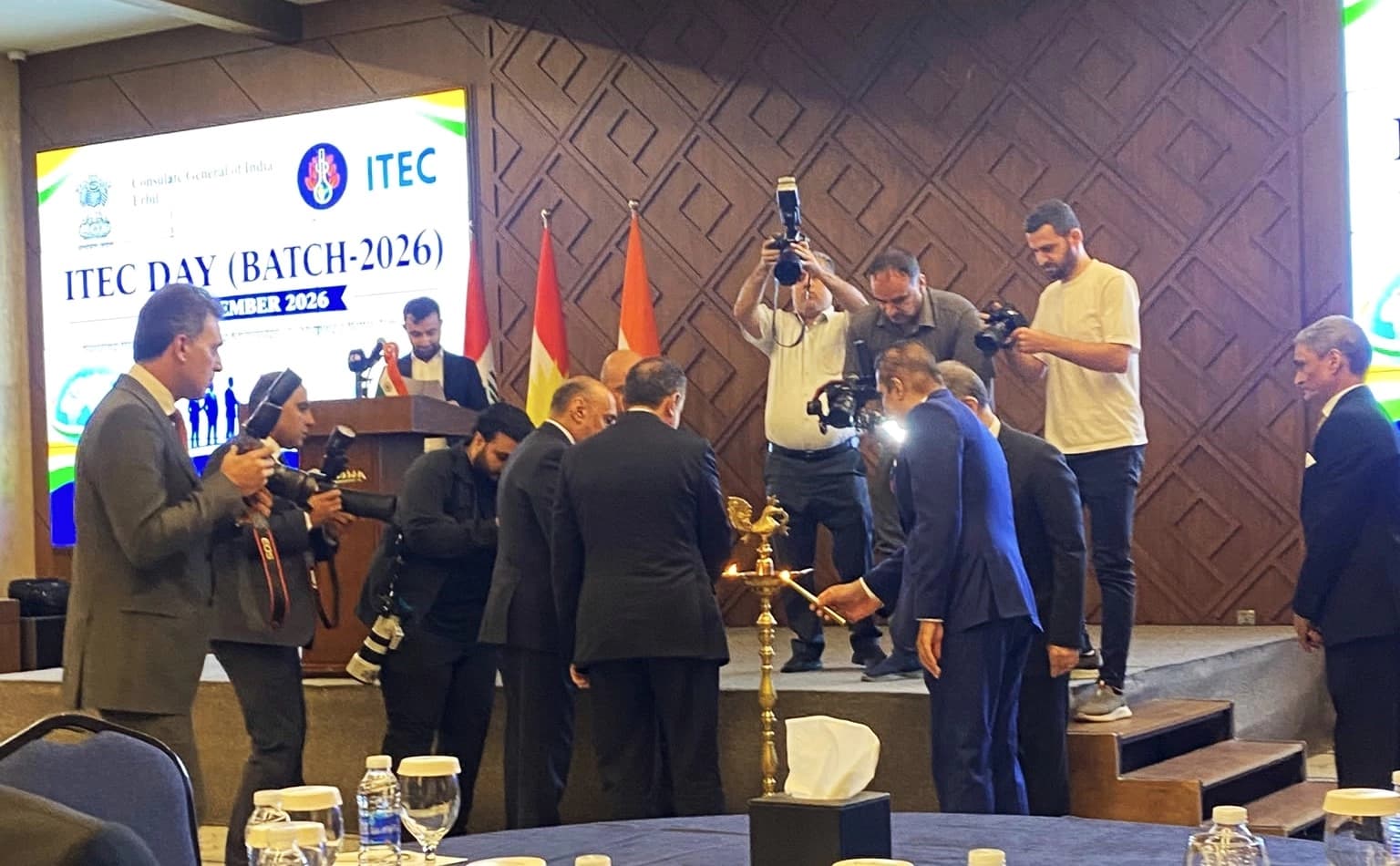

ERBIL, Kurdistan Region - Indian-Kurdish relations are flourishing, as seen in the celebration of a professional training program for Iraqis in Erbil on Thursday. Several of the Kurdish professionals who had attended various programs across India shared their exchange experiences, offering cultural understanding that could be implemented back home.
A traditional lamp-lighting ceremony - a hallmark of Hindu occasions - kicked off the event as the stage made way for stories from spirited alumni.
Thursday night’s event was dedicated to the Indian Ministry of External Affairs’ flagship program (ITEC) or Indian Technical and Economic Cooperation. The initiative invites professionals from across more than 160 countries to partake in training courses at Indian companies, NGOs and institutions.
Roughly 400 courses are offered annually, the audience was told in a video at the event; everything from yoga to accountancy, business empowerment to filmmaking. The Indian government defrays the cost of flights, accommodation, and course requirements, allowing participants from any background to attend.
Launched in 1964, the program fosters the spirit of sharing knowledge alongside developing a mutually beneficial global network for over 80,000 professionals. While skills based, the initiative rests on the mutual philosophy of ‘learning and growing,’ sharing not merely skills but understanding and friendship in lasting bonds between India and the Kurdistan Region.
In his speech, Head of the Department of the KRG’s Foreign Relations, Safeen Dizayee, discussed how initiatives such as these were valuable today for the Kurdistan Region, stressing that the KRG will continue to support the initiative in the midst of global turmoil.
A speech from Soumen Bagchi, the Indian ambassador to Iraq, similarly touched on a sense of “brotherhood” between countries that India aimed to foster through its flagship initiative.
“Not at the highest diplomatic level, but at a middle level,” he said, establishing a global community between doctors, teachers, and scientists.
Such a network is vital for any working profession; several alumni of the program highlighted this benefit in speeches made during the event.
The ambassador underscored the potential for the initiative’s growth in both Kurdistan and Iraq, citing how it had grown exponentially over the last few years.
He further highlighted how both the Indian Consulate and Embassy in Baghdad were working with the KRG to “overcome” difficulties in bureaucracy to make sure Iraqis could attend the program.
Similarly, the Consul General to Erbil, Brijesh Kumar described the initiative as an “open invitation” for Kurds and Iraqis to participate and that it was up to the Kurdish authorities to decide practicalities.
According to the Indian embassy’s website, there are 200 places earmarked for all Iraqis every year for these courses. Of the available seats this year, Kurds took up nearly 70 places.
It would appear that the Kurdistan Region was proportionally overrepresented, highlighting an ambition, passion, and willingness to learn from the Indian experts. Rory Cronin from Rudaw English spoke with three people from this year’s cohort to find out more.
Insights from Indian medicine and empowerment
One of the highlights of this year’s cohort was the “Leader Skills for Women” program that saw 25 women from all over Iraq go to New Delhi for two weeks to build, workshop, and practice skills necessary for female-led workplaces.
Nine women came from the Kurdistan Region.
Halbeen Abdulrazzaq, the head of Erbil’s Public Health Non-communicable Diseases department, outlined how the comprehensive course of seven modules had not only opened interesting avenues of non-western medicine for her, but gave her an added confidence and knowledge working day-to-day.
For Abdulrazzaq, a specialist in the prevention of issues such as smoking, heart disease, and other chronic diseases, the cultural modules that explained India’s emphasis on traditional and alternative medicines were invaluable.
Abdulrazzaq mentioned India’s Board of Lifestyle Medicine, aimed at preventing such afflictions through the root causes linked to lifestyle. She suggested that such an approach should be examined in her work in Erbil before medication is considered.
“Lifestyle, it's a new word in the western world, we can benefit from it, especially in my field of non-communicable diseases.”
The program also afforded Abdulrazzaq a rare opportunity to network with Iraqi women in her field, sharing experiences and advice with women in positions similar to her own in an environment that not only allowed but welcomed it.
She considered how such a leadership course, focusing specifically on issues relating directly to women, such as navigating the balance between professional and personal lives, was not necessarily offered in the Kurdistan Region.
“[The leadership course] is not in a package here- it was a good opportunity to have it as a package,” she said.
She added that the guidance on balancing the dual pressure of professional and personal lives was useful.
“It is very important especially for women, especially in our area because you are working outside and you have to work at home as well.”
Overall the experience was clearly a positive one for Abdulrazzaq who donned a spectacular gold sari, a traditional draped dress, to commemorate the evening.
The trip further empowered the group of women representing the cohort.
One woman said that initially travelling had been “lonely,” but the experience had allowed her to “trust” herself more to a certain degree.
Why India?
On the same day that he arrived from his program in India several weeks prior, Fateh Ramzi, 25, explained what this particular country offers to Kurds like him.
“The Indian model [of entrepreneurship] is one of the best in the world,” he said, citing its massive population and booming industrial economy.
Ramzi is the vice president of an Erbil-based NGO working on healthcare, environmental protection, research, innovation and entrepreneurship.
He described how India represented a “strategic partner" for the Kurdistan Region, particularly in his diverse fields of interest.
Ramzi’s 12-day training course outside New Delhi at the National Institute for Entrepreneurship focused on the skills and strategies necessary for entrepreneurship in the Kurdistan Region. He felt the skills he learnt would be exponentially beneficial in the expansion of his NGO outside Erbil, “into the south and rural areas of Iraq,” he added.
Ramzi was also a speaker at Thursday’s event and explained how although seemingly disparate, India and the Kurdistan Region share a common ancestral heritage. For Ramzi this meant that the “cultural openness” of India welcomed him with open arms.
The Indian Consul General to Erbil further detailed that thanks to India’s cultural diversity, Kurds visiting would find a place in any field and city no matter where in the country.
“There will not be any culture shock, there will be a variety, we are a very diverse country,” Kumar clarified.
Many attendees agreed wholeheartedly with this sentiment. The one exception was perhaps one participant who, while very happy with the ITEC course, admitted that they had “lost 5 kilograms” after discovering just how spicy the food happened to be.
Kurdish and Indian Cinema: A dream come true
Binay Shorah, from Sulaimani, undertook the "Art and Business of Indian Blockbuster Cinema" training program in February.
Hers was a unique story among the cohort as a veritable Indiaphile; from a young age she developed a love of Indian film and the legendary silver screen actor, Raj Kapoor.
As an assistant director, she seized the opportunity in Kolkata to learn from the professionals at helm of one the world’s biggest cinema industries.
Over the course of just a matter of weeks at the Satyajit Ray Film and Television Institute, Shorah found herself in a room with the top echelon of the industry, including meeting the creators of The Lunchbox, a 2013 drama that she had first seen in Kurdistan.
An aspiring writer who has worn a lot of hats in this business, as she described, she was shown the skills necessary to write a screenplay, giving her the opportunity to tell her story on her terms.
“I learned the skills during the course to write my first short screen play. I never did it here [in Kurdistan], but they inspired me,” she said.
She continued by saying that the Institute helped in showing her how to connect her story “to an international audience, how it is going to affect them.”
Beyond screenplays, the course also focused on the practical side of the industry, the often daunting task of making and producing. She described how the group of students from all over the world supported each other in the making of various projects, fostering a community of like minded international filmmakers earnestly learning from the Indian experts.
Now back on terra firma, Shorah is in the midst of rehearsing a play of short-stories in Sulaimani while sending off more applications to work in other far-off film industries. The ultimate goal however remains clear.
“I think I have to go back to India, I have to go back,” she said with a smile on her face.
Shorah’s experience in India has only stoked a love of the subcontinent, describing it during speech at the event as not merely a country, but “a feeling that will stay with you forever.”