For anyone dedicated to Kurdology and the documentation of Kurdish history, few twentieth-century figures cast as long and enduring a shadow as Erebe Shemo (Arab Shamilov, 1897–1978). Known across generations as Bavê Romana Kurdî (the Father of the Kurdish Novel), Shemo was far more than a literary pioneer. He was an architect of modern literacy, a field linguist, an early newspaper co-founder, a survivor of the Stalinist Gulag, and revered across the Caucasus as a teacher of teachers.
When I was a university student in Ankara, one of the foundational texts that shaped my worldview was Shemo’s Şivanê Kurmanca (The Kurdish Shepherd). Later, through the writings of memoirist Wezire Eso, the reality of his seventeen years of brutal exile in Siberia struck me with immense force. In those long, isolated years, Shemo recited Kurdish folktales aloud to himself so that the cadence of his mother tongue would never slip away. In an era when Kurdish identity was actively erased and criminalized across its Middle Eastern heartland, the early Soviet sphere represented the first time in modern history that Kurmanji received systematic state sponsorship, public education, and official print infrastructure.
Knowing that Shemo preserved that language against absolute isolation became a decisive turning point in my life. It inspired me to reclaim, master, and immerse myself fully in my heritage. Today, as an educator teaching Kurmanji at the university level in the United States, I see my work as a direct continuum of that Soviet-era preservation. Without the institutional foundations Shemo fought to establish, generations of Kurds in the diaspora would have been cut off from the written architecture of their own mother tongue.
Born into a Yezidi Kurdish family in Susuz, in the Kars Oblast of the Russian Empire (now part of modern-day Turkey), Shemo came of age during an era of profound regional turmoil. Following the collapse of the tsarist empire, World War I, and the redrawing of frontiers that ceded Kars to Turkey, he was exiled from his native land and forced eastward to Soviet Armenia, where Yerevan rapidly emerged as an intellectual sanctuary for the region's displaced Kurdish community.
In the early 1920s, local Kurdish schools briefly experimented with adapting the Armenian alphabet. Shemo, however, recognized that widespread literacy required a modern, accessible Latin phonetic system, an insight that aligned with the broader Soviet Latinization campaigns of that decade.
Working closely with the Assyrian linguist Isahak Marogulov in the late 1920s, Shemo laid the structural foundations of modern Kurmanji by co-creating the first official Latin-based Kurdish alphabet. Their 1928–1929 primer, Xwe bi Xwe Hînbûna Xwendina Nivîsara Kurmancî (Self-Study of Reading and Writing Kurmanji), transformed Kurdish education from an oral tradition into an institutional reality.
Shemo’s contribution went far beyond textbook design; he became the foundational educator who trained the educators. At pedagogical institutions and teacher-training seminars in Yerevan, he instructed the first generations of Kurdish schoolteachers, providing them with the linguistic methodologies and instructional tools needed to staff nearly thirty newly established Kurdish schools across Armenia, Georgia, and Azerbaijan. Through his mentorship, an entire cadre of educators and literati was born, earning him the enduring title mamosteyê mamosteyan (the teacher of teachers). In 1930, that institutional momentum was further bolstered with the launch of the historic newspaper Rya Teze (The New Path), which had Shemo as one of the foundational editors.
Shemo’s linguistic efforts culminated in a monumental milestone, the birth of the first modern Kurdish novel. Written while studying and teaching in Leningrad, his debut work, Şivanê Kurmanca, was first issued in Russian in Moscow in 1931 and published in its original Kurmanji Latin text in Yerevan in 1935.
Before Shemo, Kurdish literature was primarily defined by classical verse, mystical epics, and the oral memory of the Dengbêj. With Şivanê Kurmanca however, Shemo broke entirely new ground. He took the cadence, idioms, and the harsh realities of pastoral life and forged them into semi-autobiographical realistic modern prose. The novel provided a moving account of rural Kurdish society navigating the collapse of feudal structures and the arrival of modern institutions. The novel also proved that Kurmanji was fully capable of sustaining long-form narrative literature.
In the early 1930s, Shemo was active in Leningrad’s leading academic and orientalist circles. He taught Kurmanji at the Leningrad Institute of History, Philosophy, Literature, and Linguistics (LIFLI) and conducted postgraduate research at the State Academy for the History of Material Culture. Working alongside scholars such as Professor Qanate Kurdo (Kanat Kurdoev), Shemo entwined creative writing and rigorous linguistic methodology. In late summer 1933, he organized and led a field research expedition across Kurdish areas of Armenia, Azerbaijan, and Georgia for the Scientific Research Institute of Nationalities. The mission was clear: systematically document local dialects, examine living conditions, and help establish a unified, standardized literary Kurmanji language.
This cultural renaissance was brutally halted by the Stalinist purges. In early January 1937, after authorities discovered correspondence in which Shemo petitioned Soviet leadership for greater resources to support Kurdish schools and literature, he was arrested in Leningrad and sentenced to exile once again, this time to the gulag.
During those seventeen grueling years in penal labor in Siberia, his spirit and resolve never broke. There, he also met his wife, Maria Nikolaevna, a dispossessed farm woman who would go on to stand faithfully by him through years of hardship before they were finally permitted to return to the Caucasus in the mid-1950s.
His so-called rehabilitation in the public consciousness came after Stalin’s death, a bureaucratic decree that cleared his name only after robbing him of seventeen years of his youth. Shemo returned to Yerevan and entered his most prolific creative period. He published a succession of foundational works, including Berbang (Dawn, 1958), Jiyana Bextewar (A Happy Life, 1959), and Hopo (1969). His crowning achievement came in 1966 with Kela Dimdim (The Fortress of Dimdim). Rather than leaving the historic 1609 siege of Dimdim solely within the oral dengbêj tradition, Shemo adapted it into a sweeping historical novel that permanently anchored one of the most vital symbols of Kurdish resilience in world literature. In 1967, his anthology Hikayetên Gelê Kurd (Tales of the Kurdish People) systematically documented and preserved hundreds of oral narratives.
Beyond his published works, Shemo possessed an exceptional moral character and personal generosity that left a lasting impression on everyone around him. During my own field research in Yerevan, conversations with local Kurdish community figures and contemporaries confirmed the restraint he showed upon his return from exile. When, for instance, he discovered that a fellow Kurd had penned the false denunciation leading to his arrest, Shemo adamantly refused to seek legal retribution or public exposure, insisting that Kurds should never be seen betraying or intriguing against one another.
That protective instinct for his Kurdish people defined his entire public life. Whenever a young or underprivileged Kurd needed university admission, housing, or official bureaucratic help in Armenia, Shemo would pin all his state medals to his jacket, march directly into the ministries in Yerevan, and resolve the matter on the spot. Born into a respected religious lineage in traditional Yezidi society, he flatly rejected traditional feudal privilege, dedicating his life to defending the poor against social and economic exploitation.
The researcher Temure Xelil noted that Shemo had complete command of seven languages: Kurdish, Russian, Armenian, Azerbaijani, Turkish, Georgian, and German. His oral memory was legendary, capable of reciting multi-generational lineages on the spot during conversation, a reflection of the deep dengbêj memory that informed his literary voice.
That living connection reaches far beyond Armenia. Four years ago, during a visit to Georgia, I was sitting late into the night chatting with a Kurdish host in his home in Tbilisi. When the conversation turned to Shemo’s legacy, my host leapt up with unmistakable joy, explaining that his mother was Shemo’s niece, making the literary pioneer his own great-uncle. In that spontaneous, warm moment in Tbilisi, framed by the Kurdish and Georgian flags in the room, the vast historical diaspora of the South Caucasus felt intimately close. Shemo was not just a name preserved in state archives; his memory remained a vibrant, personal presence in the living rooms of families scattered across the region.
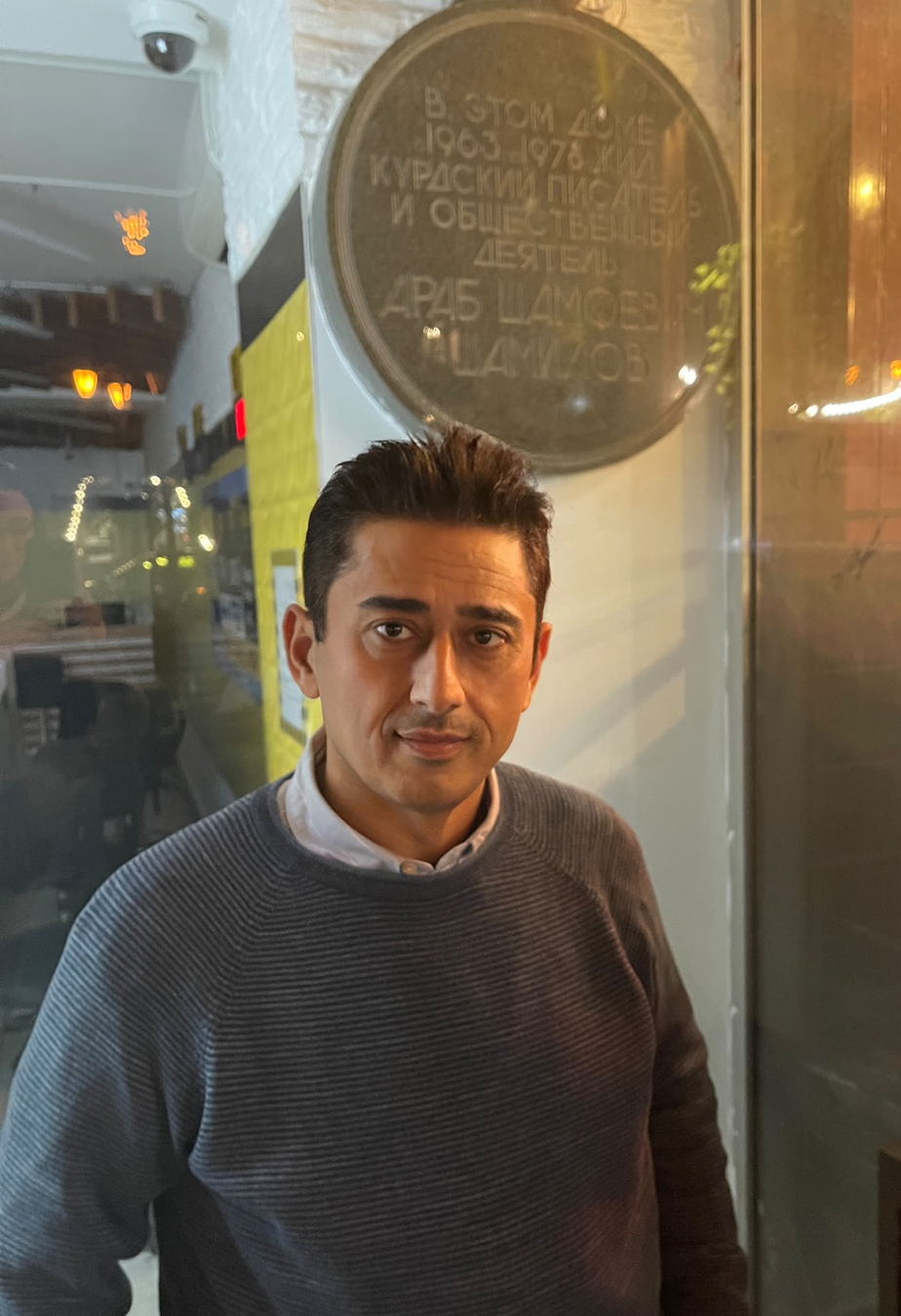 Civiroglu stands in front of a plaque in Erebe Shemo’s former building in Yerevan. The bronze memorial plaque is translated from Russian as, “The Kurdish writer and social activist, Arab Shamoyevich Shamilov lived in this house.”
During my time in Yerevan, I sought out the building on Abovyan Street where Shemo lived from 1963 until his death in 1978. It was a deeply moving experience to stand before the bronze Russian memorial plaque affixed to its wall, which honors him as an eminent Kurdish writer and public figure. Throughout my stay, I made a point of regularly walking past that building, pausing to reflect on his sacrifices.
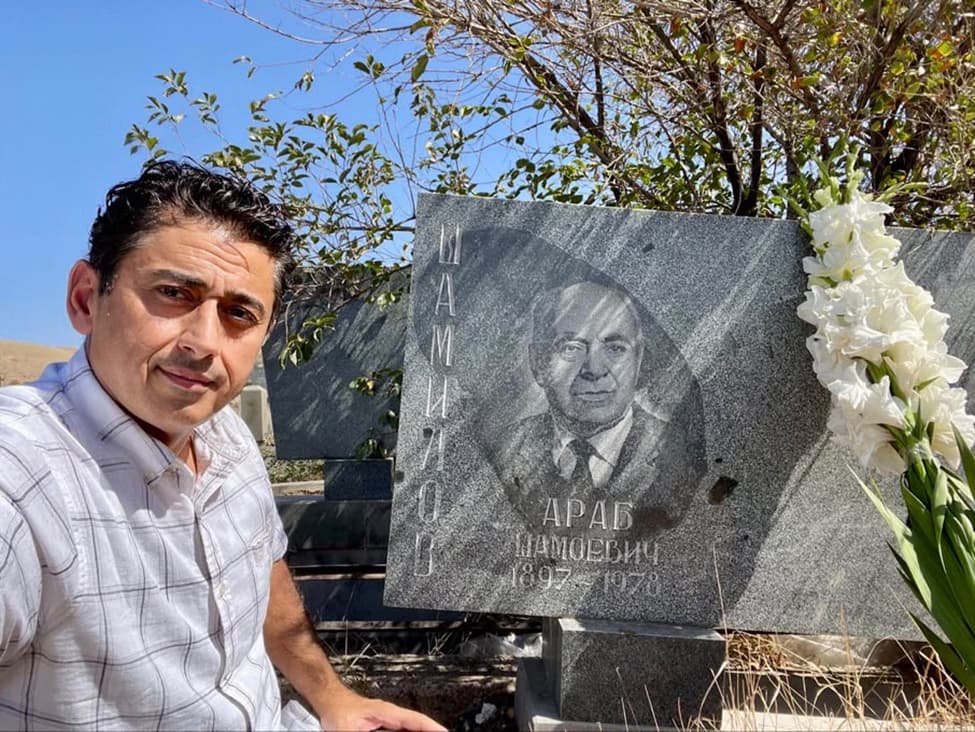
My journey culminated at his final resting place in Yerevan's Arin Berd Pantheon in Nubarashen. When Shemo passed away in the summer of 1978, his farewell became a historic gathering that reflected his significance across national borders. The Kurdish writer Eskere Boyik who was among those present describes how in the grand state hall in Yerevan, his flower-draped casket was surrounded by members of the Armenian Writers' Union and senior state officials as well as massive Kurdish delegations who traveled from villages and cities across Armenia, Georgia, and Azerbaijan. Kurdish women in traditional garments sat beside the casket, chanting ancient laments and singing şîn in mourning, while a veritable sea of people gathered to pay their respects before he was escorted to the Pantheon. Decades later, kneeling beside his granite headstone and laying a bouquet of white gladioli across the stone, the weight of his legacy became tangible. Looking at the etched portrait of the pioneer who weathered the bitter Siberian cold with his dignity intact, the debt owed by every subsequent generation of Kurdish writers and teachers felt immediate and profound.
For scholars, educators, and journalists in Kurdology today, Erebe Shemo is far more than a historical name on a dusty bookshelf. His legacy demonstrates that linguistic research, alphabet construction, teacher training, and literary creation are all profound acts of cultural survival. From his first exile from the highlands of Kars to the university halls of Leningrad, through seventeen years of Siberian banishment, and back to his triumphant return to Yerevan’s literary circles, his life embodies the unbroken endurance of the Kurdish language. From Diyarbakir and Qamishli to Mahabad and Sulaimani, his impact extends far beyond Kurmanji. Indeed recognized across the Kurdish world as the father of the modern Kurdish novel, every writer, scholar, and educator today builds upon the ground that the teacher of teachers broke with his courage, scholarship, and vision.
A rare photo from Civiroglu’s personal archives, Erebê Shemo as ‘teacher of teachers’ in the grey suit with the legendary folklorist Hecîyê Cindî to his left and renowned poet Reşîdê Kurd on his right. Standing behind them are students who would later become distinguished academics, dedicating their lives to the preservation and advancement of Kurdish language, culture, and literature for generations.
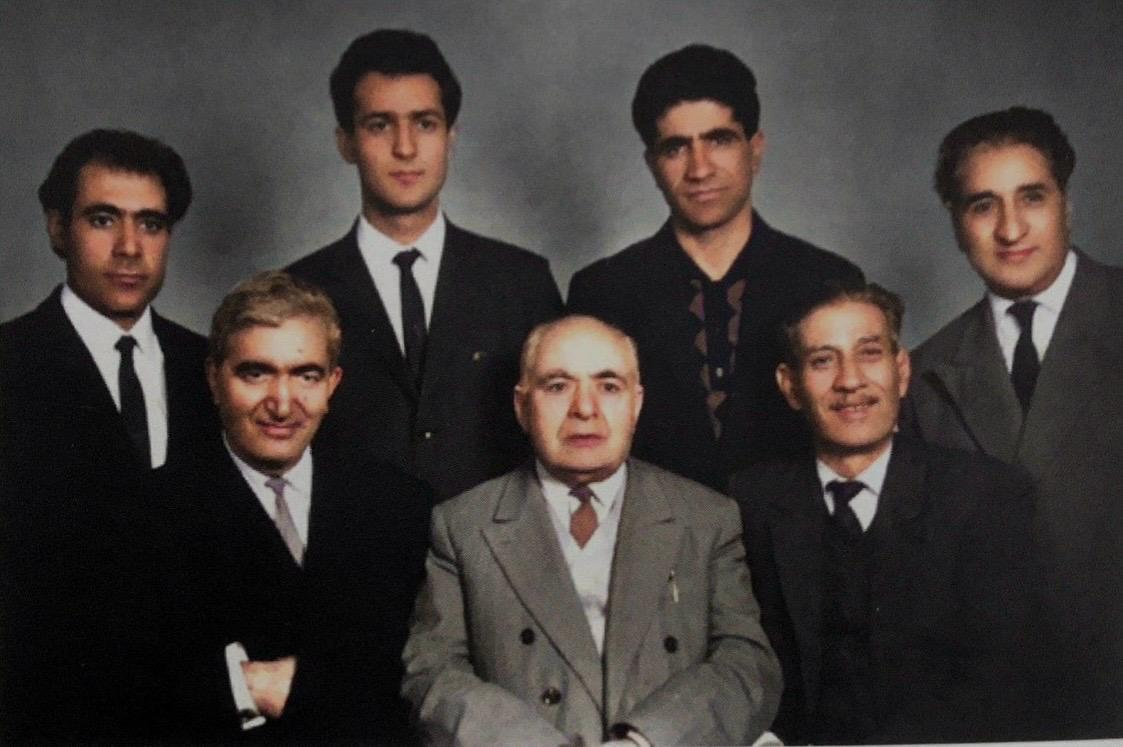 A rare photo from Civiroglu’s personal archives, Erebe Semo as ‘teacher of teachers’ in the grey suit with the legendary folklorist Heciye Cindi to his left and renowned poet Reside Kurd on his right. Standing behind them are students who would later become distinguished academics, dedicating their lives to the preservation and advancement of Kurdish language, culture, and literature for generations.
Mutlu Civiroglu is a Washington-based geopolitical analyst and journalist specializing in Kurdish affairs and Middle Eastern politics. He worked as an editor at the Voice of America Kurdish Service for 17 years and teaches Kurdish at the university level in the United States