
ERBIL, Kurdistan Region - Iraqi Prime Minister Ali al-Zaidi headed to Syria on Wednesday on his first official visit to Damascus since taking office, as Syrian President Ahmed al-Sharaa called for closer economic and security cooperation between the neighboring countries, highlighting opportunities to develop oil export routes and address shared regional challenges.
Zaidi is leading a high-level ministerial delegation and is expected to meet Sharaa to discuss bilateral relations, regional developments and their geopolitical implications, Iraqi government spokesperson Haidar al-Aboudi said in remarks carried by the state-owned Iraqi News Agency (INA).
Economic and trade cooperation will be a priority, Aboudi said, as the two governments seek to expand investment and strengthen commercial ties.
The visit comes amid renewed diplomatic engagement between Baghdad and Damascus following the overthrow of former Syrian President Bashar al-Assad in December 2024, with both governments seeking closer cooperation on border security, trade, oil exports and shared water resources.
Speaking to Iraq's al-Dijla TV in an interview aired Tuesday evening, Sharaa welcomed Zaidi's visit, describing relations between the two countries as historically rooted in shared tribal, social and economic ties.
"Our fate is tied together, historically, now, and in the future," Sharaa said, arguing that relations should be built on common interests rather than the political preferences of those in power.
The Syrian president praised Baghdad's approach toward the new Syrian authorities, saying the Iraqi government had maintained a positive position despite attempts by some political parties to influence its decisions against Damascus.
He also credited former Iraqi Prime Minister Mohammed Shia al-Sudani with resisting those efforts.
"I would like to repeat and reiterate that the central government in Baghdad dealt with us positively. There was an attempt to disrupt the Iraqi government's decision, but at the end of the day, the truth wins," Sharaa said.
Oil exports and economic cooperation
Sharaa emphasized Syria's potential to provide Iraq with alternative routes to international markets, particularly through its Mediterranean ports, as Baghdad seeks to reduce its reliance on the Strait of Hormuz amid disruptions caused by the regional war between the US and Iran.
"Syria serves as Iraq's maritime gateway - its outlet to the Mediterranean Sea, irrespective of us being one or two different states," Sharaa said.
He proposed linking southern Iraq's Grand Faw Port to Syria's Tartous port and reviving oil pipelines connecting Iraqi production facilities to the Mediterranean.
"Iraqi oil also needs outlets for export. The best and easiest would be Syria's ports on the Mediterranean," he said.
Since the outbreak of the US-Israeli war against Iran in late February, Iraqi oil exports plunged from more than 99 million barrels in February to 18.6 million barrels in March before recovering to more than 3.4 million barrels per day in October, according to figures from the Iraqi Oil Ministry.
Baghdad has been exploring alternative export infrastructure, including the proposed Basra-Haditha pipeline and connections to Syria's Baniyas port, Turkey's Ceyhan port and Jordan's Aqaba port.
Sharaa also highlighted growing commercial activity between the two countries, saying more than 100,000 transit trucks had passed through Syria over the past six to seven months, alongside over 40,000 trucks carrying imports and exports between Iraq and Syria.
The Syrian president called for greater cooperation in managing shared water resources and developing agriculture, arguing that the two countries' agricultural lands could help meet the food needs of more than 100 million people.
"The topic of shared water is the most important," he said, calling for a unified strategy to develop agricultural production.
Security cooperation
On security, Sharaa said Syria was working to address Iraqi concerns by strengthening border controls and preventing smuggling and infiltration of militants.
He claimed that the shared border was secure and that the two governments maintained direct communication whenever security concerns arose.
The Syrian president also said the threat from the Islamic State (ISIS) had diminished, although the group had not been completely eliminated.
"Daesh's threat has gradually receded. It isn't over in a manner of complete certainty, but it isn't like it used to be," he said, using the Arabic acronym for ISIS.
Sharaa expressed strong support for Zaidi's efforts to bring weapons under state control, saying governments must retain sole authority over decisions of war and peace, particularly amid the ongoing regional conflict.
He also addressed the fate of Syrian nationals among ISIS suspects transferred to Iraqi custody during the withdrawal of US-led coalition forces from Syria, saying that judicial authorities in both Baghdad and Damascus had discussed reviewing the detainees' cases and identifying those who could be returned to Syria, arguing that Damascus should assume responsibility for its citizens.
"At the end of the day, these are Syrians, and the Syrian state needs to handle them, to remove this burden on Iraq," he said.
Zaidi's visit follows a series of regional diplomatic engagements, including trips to Saudi Arabia and Jordan earlier this month, as Baghdad seeks to strengthen economic ties and prevent the regional conflict from spreading.
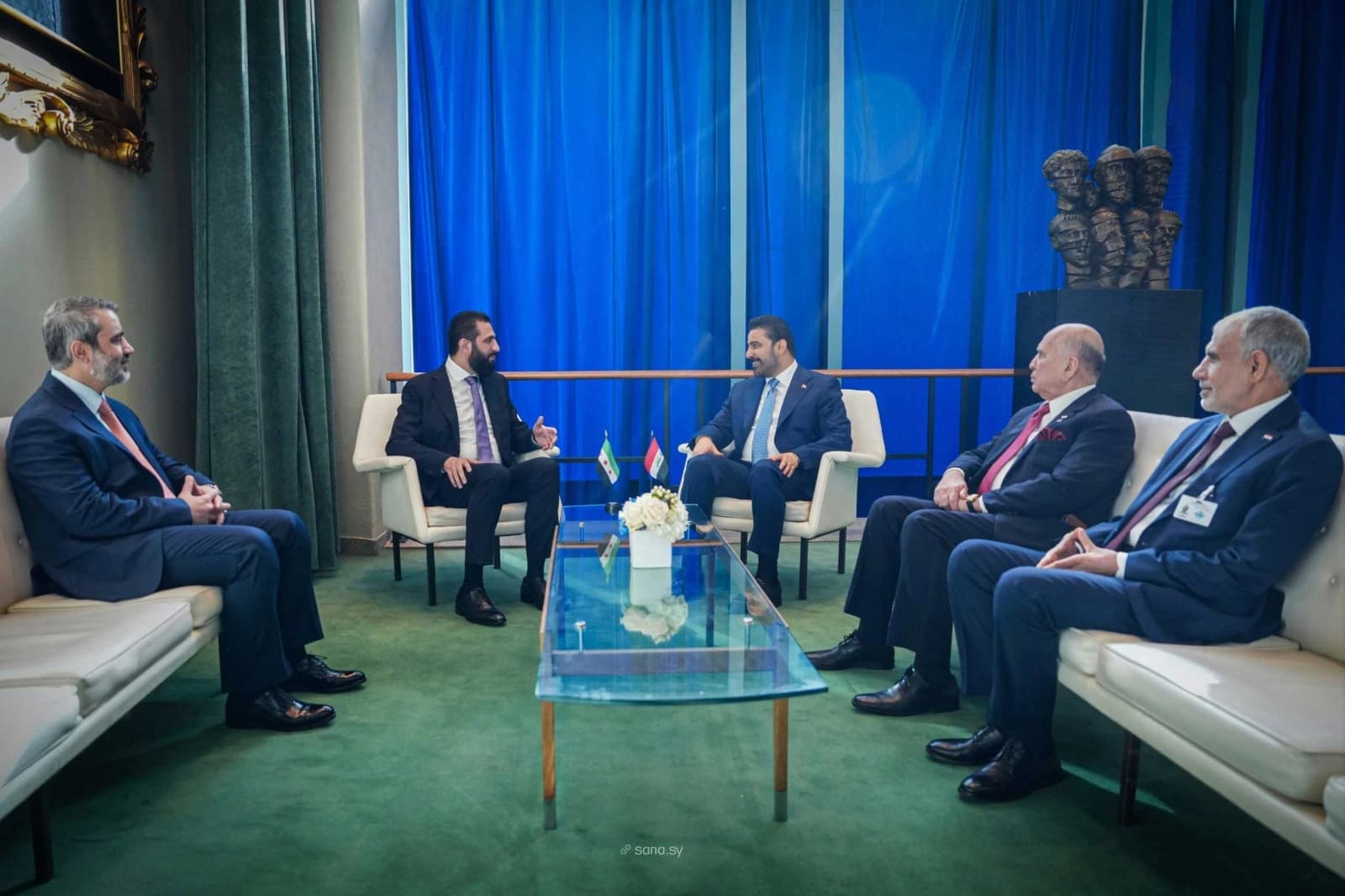
Last month, Zaidi met with Sharaa in New York on the sidelines of the 81st session of the United Nations General Assembly.
In July 2023, former Iraqi Prime Minister Sudani visited Damascus and met Assad, becoming the first Iraqi premier to make such a visit since the outbreak of Syria's civil war in 2011.
Wednesday's visit marks Zaidi's first official engagement in Damascus as prime minister under Syria's new leadership.